


The playlist is ready. The snacks are packed. Everyone has saved restaurants, scenic overlooks, hiking trails, and places that should look good in the group photos.
A girls' RV trip can begin feeling relaxed long before the campsite comes into view. The drive itself can be part of the experience: shared music, unexpected roadside stops, local markets, and enough flexibility to follow a recommendation that was never included in the original plan.
Then the group reaches a crowded visitor center.
The parking spaces are shorter than expected. The easiest route through the lot is blocked by delivery vehicles. Later, the campground assigns a back-in site between a utility post and another RV, and the daylight arrival slowly becomes a low-light maneuver after a longer driving day than anyone planned.
This is where a fun trip can become tense. One friend stands outside trying to guide the rear corner. Another watches the navigation screen. The driver sees the mirrors and a small part of the site, but nobody has exactly the same view.
The challenge is not that women are less capable of driving an RV. Any driver can feel uncertain when operating an unfamiliar vehicle with a longer wheelbase, wider body, larger rear overhang, and more blind areas than a passenger car.
However, a women-led RV trip can include practical needs that a generic road-trip checklist may overlook. Some friends may have had fewer opportunities to practise in a large vehicle. The seat, mirrors, steering wheel, and controls may still be adjusted for a taller previous driver. The group may also want a clearer plan for restroom access, period care, privacy, late-night stops, location sharing, and how to respond if an unfamiliar place feels uncomfortable.
Good teamwork helps, but teamwork works better when the roles, signals, route, personal-comfort needs, and arrival routine have already been discussed. An RV backup camera may provide additional rear or side information, yet it should remain one part of a broader process that includes mirrors, direct observation, a walk-around, and a visible spotter.
This guide explains how to plan a girls' RV trip around shared experiences, divide responsibilities without making the vacation feel like work, prepare for women-specific comfort and privacy needs, manage realistic driving days, and handle the slow parking moments that often create more pressure than the highway.
Quick Navigation
- Quick Girls' RV Trip Answer
- Plan Around Shared Experiences
- Assign Clear Group Roles
- Plan for Women-Specific Needs
- Plan Realistic Driving Days
- Prepare for Slow, Awkward Moments
- Practise Parking Before the Trip
- Create a Spotter System
- Build Shared Visual Context
- Prepare a Late-Arrival Plan
- Use Smart Reversing Assist
- Use Flexible Dual Views
- Add Wider Rear and Side Context
- Use the Group Trip Checklist
- Frequently Asked Questions
Important: Camera systems can add useful visual information, but they cannot guarantee accident prevention or show every obstacle around an RV. Continue using mirrors, direct observation, a walk-around, a visible spotter, and driver judgment. Confirm vehicle compatibility, installation requirements, and power needs before travel.
Quick Answer: How Do You Plan a Smoother Girls' RV Trip?
Start with the experiences everyone genuinely wants, then build a realistic route around them.
Give each person a clear role, keep driving days short enough that the group still has energy at arrival, practise parking before the first busy campground, and agree on one simple spotter system. Save campground instructions, prepare a backup overnight option, and test all camera views before departure.
The trip stays more enjoyable when the driver is not expected to navigate, manage the music, find the entrance, answer questions, and reverse the RV at the same time.
For an all-women group, also plan for restroom availability, menstrual products and medication, changing privacy, well-lit fuel stops, location-sharing rules, and a backup option when a campsite or overnight stop does not feel right. Before anyone drives, confirm that the seat, mirrors, steering wheel, and pedals can be used comfortably without compromising control or visibility.
| Trip Stage | Common Pressure | Preparation |
|---|---|---|
| Route planning | Everyone wants different stops | Choose shared themes and a small number of anchor experiences |
| Driving day | The schedule becomes too full | Set a realistic time limit and add an arrival buffer |
| Scenic stop | Parking is short or crowded | Check large-vehicle access before leaving the main route |
| Fuel stop | Canopy, pump direction, or exit is difficult | Select stations by access rather than price alone |
| Campsite arrival | The group is tired and backing space is tight | Arrive in daylight and walk the site before moving in |
| Spotter communication | Several people give different instructions | Choose one primary spotter and agree on simple signals |
| Rear and side visibility | Each person sees a different part of the space | Use mirrors, direct checks, and camera views as shared context |
| Plan changes | Weather, traffic, or availability changes | Keep backup routes, stops, and overnight options |
| Driver fit | Seat, mirrors, or pedals do not suit every driver | Adjust the driving position and practise before departure |
| Restroom and period care | Remote stops may lack clean facilities or disposal options | Pack supplies, sealed waste bags, water, and a restroom plan |
| Personal safety and privacy | An isolated stop or late arrival feels uncomfortable | Use well-reviewed locations, share plans, and keep a backup stop |
Step 1: Plan the Trip Around Experiences Everyone Wants
A memorable RV trip is usually easier to plan when the group starts with experiences instead of a long list of destinations.
Ask what everyone wants the trip to feel like. The answer may be more useful than asking how many places can fit into six days.
Choose a Shared Trip Theme
The trip may focus on:
- national parks and hiking
- coastal roads and beaches
- food, farmers markets, and local restaurants
- wineries, farms, or small-town stops
- photography and scenic drives
- music, art, or cultural events
- wellness and slower travel
- a combination of outdoor activity and comfortable downtime
A theme provides direction without forcing every hour into a fixed schedule.
Let Each Person Choose One Priority
Each traveler can select:
- one experience that matters most
- one flexible stop
- one weather-proof or low-energy alternative
This gives everyone meaningful input while preventing the itinerary from becoming a competition between saved locations.
Separate Anchor Stops From Optional Stops
Use three categories:
- Anchor stops: reservations, events, or experiences that shape the route
- Flexible stops: activities worth doing if time and weather cooperate
- Easy-to-skip stops: interesting ideas that should not create pressure
Anchor stops provide structure. Flexible stops leave room for a local recommendation, a longer lunch, a change in weather, or a campsite that deserves another morning.
Plan the Experience Around RV Access
Before adding a scenic attraction, confirm:
- whether RV parking is available
- whether the entrance has a height or length limit
- whether the road requires a difficult turnaround
- whether another parking option exists nearby
- whether arriving earlier would reduce congestion
A stop can still be worth visiting when the RV needs to remain farther away. The plan simply needs to account for the size of the vehicle.
Step 2: Assign Roles Without Turning the Trip Into a Work Schedule
Clear roles reduce confusion, especially when the route changes or the vehicle enters a crowded area.
The roles do not need to be formal, and they can change each day.
| Role | Main Responsibility |
|---|---|
| Current driver | Vehicle control, speed, lane position, and the final decision to stop |
| Co-driver | Navigation, road signs, fuel planning, and advance turn instructions |
| Campground lead | Reservations, entrance details, site number, gate code, and check-in rules |
| Weather lead | Forecasts, wind, storms, heat, road conditions, and route changes |
| Food lead | Meals, groceries, drinking water, and easy travel-day snacks |
| Vehicle-check lead | Walk-arounds, exterior doors, steps, awnings, lenses, and equipment checks |
| Photo and memory lead | Shared albums, trip notes, and group photos when the RV is safely parked |
Keep the Driver's Job Manageable
The driver should not be expected to:
- hold the phone for navigation
- search for the campsite entrance
- answer messages
- choose music
- read the campground email
- decide where everyone wants to eat
- interpret several voices during backing
The co-driver can prepare the next instruction early and identify which lane, entrance, or fuel pump is most practical.
Rotate Roles According to Skill and Energy
Someone who drives in the morning may prefer to handle navigation later. Another traveler may feel more comfortable as the campground lead or spotter.
Rotation should be based on current energy and confidence, not a rigid schedule. A person who is tired, uncomfortable, or unfamiliar with the road conditions should be able to step back without creating tension.
Give the Driver Authority to Stop
The driver should stop whenever:
- the view becomes uncertain
- the spotter disappears
- the route appears unsuitable
- fatigue affects concentration
- the instructions conflict
- another person or vehicle enters the maneuvering area
Stopping is part of the process. It does not need a group vote.
Step 3: Plan for Women-Specific Comfort, Privacy, and Safety Needs
Women do not need a different standard of RV driving, but an all-women group may have practical needs that deserve their own place in the itinerary.
The goal is not to assume that every traveler has the same concerns. It is to discuss the details before departure so nobody has to solve a private, physical, or safety-related problem under pressure.
Make the Driving Position Fit Every Driver
An RV may have been adjusted for a previous owner or rental customer whose height and reach are very different from the next driver.
Before entering traffic, each driver should check:
- seat distance from the pedals
- seat height and backrest angle
- steering-wheel position where adjustable
- clear visibility over the dashboard
- left and right mirror coverage
- comfortable reach to indicators, lights, wipers, and hazard controls
- whether the camera display blocks any forward view
A driver should not stretch to reach the pedals or sit so close that steering becomes restricted. Use only vehicle-approved adjustments and accessories, and complete a short practice session before the travel day begins.
Plan Restroom, Period, and Personal-Care Stops
Remote routes, dispersed campsites, and scenic roads may offer fewer clean or private facilities than the group expects.
Before leaving a town, confirm:
- where the next reliable restroom is located
- whether the campsite has toilets, showers, or water
- how menstrual products and personal waste will be stored and packed out
- whether the RV has enough toilet supplies, water, soap, and hand sanitiser
- where personal medication can be stored according to its instructions
- whether anyone needs more frequent breaks because of period symptoms, pregnancy, motion sickness, or another personal health need
Carry spare menstrual products even when nobody expects to need them. Include opaque, sealable bags for disposal where bins are unavailable, and follow local waste rules.
Group-planning reminder: Bathroom, period, medication, and rest needs are not schedule failures. Build enough flexibility into the route so a traveler can ask for a stop without having to justify it to the group.
Create a Personal-Safety Plan for Stops and Overnight Stays
An all-women group may feel more comfortable when everyone knows how the group will evaluate an unfamiliar fuel station, parking area, host property, or campsite.
Useful agreements include:
- prefer well-lit fuel and grocery stops when practical
- review the entrance and recent location information before arrival
- arrive at isolated campsites in daylight where possible
- share the route and expected overnight location with a trusted contact
- keep phones, flashlights, and vehicle keys accessible
- avoid telling strangers the complete itinerary or that the group is travelling without another vehicle
- delay public posts that reveal the exact campsite until after leaving
- leave when the surroundings or interaction feels wrong, even when the reservation has already been paid
The group does not need to prove that a location is dangerous before choosing another stop. A backup option turns an uncomfortable feeling into a practical route change.
Rear and side cameras may help the driver understand the area around the RV during parking. They are not personal-security systems and do not monitor the complete campsite.
Protect Privacy Inside a Shared RV
A compact RV can make changing, sleeping, showering, and personal care feel less private than a hotel room.
Discuss:
- who sleeps where
- when curtains or privacy screens should remain closed
- how the bathroom and changing area will be scheduled
- where wet clothing and personal laundry will be stored
- whether anyone needs quiet or private time
- when photos and videos may be taken inside the RV
- whether every traveler consents before a location or image is posted online
These conversations may feel overly detailed before the trip, but they prevent small privacy issues from becoming group tension after several days in a confined space.
Divide Physical Tasks by Comfort and Technique
Hookups, levelling blocks, storage doors, bicycles, and campsite equipment can require awkward lifting or reaching.
Assign these tasks according to experience, comfort, and the correct technique rather than gender or a fixed trip role.
- use gloves for hoses, hitches, and dirty equipment
- use a stable step where the manufacturer permits it
- lift bicycles or heavy gear with two people when needed
- use tools designed for stabilisers and levelling equipment
- stop when a task requires unsafe force or reach
- ask campground staff or another appropriate helper rather than improvising
No traveler should feel pressured to lift, climb, or connect equipment beyond her comfort level simply to prove independence.
Check Power Before Using Personal-Care Appliances
Hair dryers, heated styling tools, electric kettles, and similar appliances can draw significant power.
Before using them, confirm:
- whether the RV is connected to shore power
- the inverter and outlet limits
- whether another high-draw appliance is already operating
- the campground's electrical rules
- whether the device and outlet are suitable for the available supply
Do not overload the RV electrical system or use an unsuitable extension arrangement for convenience.
Step 4: Plan Driving Days That Leave Energy for the Evening
An itinerary can look relaxed on a map and still feel exhausting in an RV.
Fuel stops take longer. Grocery parking may require a wider route through the lot. Campground check-in, site inspection, backing, leveling, and hookups all happen after the navigation app says the group has arrived.

Plan by Time and Road Type
Consider:
- highway versus mountain roads
- urban traffic
- construction
- weather
- fuel and meal stops
- how many people are comfortable driving
- the difficulty of the final campground approach
Two hundred miles of open highway and two hundred miles of curves, towns, and elevation changes do not create the same driving day.
Add an Arrival Buffer
Leave time for:
- missing the entrance and returning safely
- campground check-in
- finding the site
- walking the space
- moving a picnic table where permitted
- backing and resetting
- leveling
- connecting water and power
If the planned arrival already depends on every fuel stop and traffic light going exactly as expected, the schedule is too tight.
Protect the Final Hour of the Day
The last hour should not be treated as unused driving capacity. Keep it available for the campsite entrance and setup.
A group that arrives with enough daylight and attention can handle a complicated site more calmly than a group that has spent the final hour trying to recover lost time.
Create a Fatigue Rule
Use a clear rule before the trip begins: when concentration drops, the plan changes.
Signs may include:
- repeated missed turns
- slower reactions
- difficulty judging lane position
- irritability over small decisions
- confusion about the next stop
- pressure to reach a difficult site after dark
Choose an easier overnight option or stop earlier rather than forcing a tense arrival.
Leave room for additional restroom stops, period discomfort, pregnancy-related comfort needs where applicable, medication timing, or simply a traveler needing more recovery time. These needs should influence the driving plan rather than being treated as delays that must be recovered later.
Step 5: The Hardest Moments Are Usually Slow and Awkward
The highway may feel intimidating before the trip, but many of the most demanding moments happen below walking speed.
Campsite Backing
The driver may need to judge:
- rear stopping distance
- passenger-side rear clearance
- utility posts
- trees and branches
- fire rings
- picnic tables
- neighboring slide-outs
- the path for the entrance door
The assigned site may fit the RV on paper while leaving little room for an imperfect approach.
Parking Near Restrooms and Visitor Centers
These locations may include:
- pedestrians moving unpredictably
- children and pets
- cars leaving short spaces
- low parking blocks
- shopping carts
- delivery vehicles
- drivers focused on finding their own space
Use perimeter parking when available and avoid backing into the busiest pedestrian area.
If someone needs quick restroom access, the RV does not have to use the closest short parking space. A safer option may be to park in a longer perimeter space and let passengers walk together to the facility while the driver remains with the vehicle.
Scenic Overlooks
A viewpoint may have enough room for cars and still offer no practical place for a long motorhome or trailer.
Do not enter a short dead-end lot because the view is close. Confirm the turnaround before committing the RV.
Fuel Stations
Check the canopy height, pump direction, turning area, and exit before entering. The cheapest station is not always the easiest station for a large vehicle.
Residential Driveways and Host Properties
Mailboxes, low branches, narrow gates, decorative walls, parked cars, and steep driveway transitions can make these locations more demanding than a campground.
Low-speed driving deserves the same preparation as highway driving because the available space is smaller and several blind areas may matter at once.
Step 6: Practise Parking Before the First Busy Stop
Every person who expects to drive should practise in a legal, open, low-traffic area.
The first backing attempt should not happen after dark while another RV waits behind the group.
Practise Useful Maneuvers
- straight-line backing
- driver-side backing
- offset backing
- wide turns
- pulling forward to reset
- parking between cones
- judging rear stopping distance
- using mirrors and screens together
- stopping for another walk-around
Rotate Drivers in Low-Pressure Conditions
A person can learn the controls and vehicle movement before taking over during a real travel day.
Practise:
- adjusting the mirrors and seat
- finding the hazard lights
- understanding the parking brake
- using the display without handling it while driving
- pulling into a large fuel lane
- making a safe missed-turn recovery
Use Cones Instead of Real Obstacles
Cones allow the group to see how the rear corner moves without risking a vehicle, tree, wall, or campground post.
Driver's tip: A reset is a normal part of backing. Pulling forward is often the clearest way to restore the angle and bring the difficult side back into view.
Step 7: Create a Spotter System Everyone Understands
Backing becomes confusing when several people try to help at the same time.
One person points left. Another says the rear needs to move right. Someone else notices the tree on the opposite corner. The driver hears all three instructions but cannot tell which one has priority.
Choose One Primary Spotter
The primary spotter gives the movement instructions.
Other group members can:
- keep pedestrians and pets away
- watch a separate hazard
- call a clear stop when needed
- remain quiet unless they see an immediate problem

Define Left and Right Clearly
Decide whether signals describe the direction of the rear of the RV or the direction the steering wheel should move.
Describing the rear is often clearer:
- rear left
- rear right
- continue slowly
- stop
- pull forward
- reset
- distance remaining
Keep the Spotter Visible
The spotter should stand where the driver can see them in a mirror or agreed camera view while remaining outside the vehicle path.
If the driver loses sight of the spotter, the RV stops. The previous instruction does not continue indefinitely.
Use Phones or Radios as Support
Voice communication can help when the distance is larger, but the same stopping rule applies. A dropped call, unclear instruction, or audio delay means the vehicle stops until the group restores a reliable visual plan.
Keep the Conversation Neutral
Use short factual instructions. Avoid jokes, blame, and several explanations while the RV is moving.
After the vehicle stops, the group can discuss a new approach.
Step 8: Better Visibility Gives the Group Shared Visual Context
The driver, co-driver, and spotter naturally see different parts of the space.
The driver sees the mirrors and display. The spotter may see one rear corner clearly but not the opposite side. A passenger may notice traffic or a pedestrian outside both views.
A camera system can help the driver understand the area the spotter is describing, but it does not create a complete view of the RV.
Useful Camera Questions
Assign a purpose to each view:
- How much distance remains behind the bumper?
- Where is the passenger-side rear corner?
- Is a vehicle approaching from behind?
- Is the trailer tracking toward the curb?
- Has a person entered the backing area?
- Is the hitch aligned?
- Where is the campsite boundary?
What the Screen Cannot Confirm
A camera may not show:
- an overhead branch
- soft or unstable ground
- an obstacle outside the field of view
- the complete opposite side
- a spotter who moved out of frame
- whether the chosen campsite is suitable
The screen should support a plan created through direct inspection. It should not replace that inspection.
Step 9: Prepare a Late-Arrival Plan Before Anyone Needs It
Every group plans to reach the campsite before dark. Traffic, weather, fuel delays, and an enjoyable unplanned stop may change that timing.
Save the Arrival Information
Keep offline copies of:
- campground address
- entrance photo or map
- gate code
- site number
- late-arrival instructions
- host contact details
- quiet-hour rules
- a backup overnight option
Use a Night-Arrival Sequence
- Stop before entering the final space.
- Walk the site when it is safe.
- Identify overhead, side, ground, and rear hazards.
- Choose one primary spotter.
- Keep other people away from the reversing path.
- Use mirrors and camera views together.
- Move slowly enough to stop immediately.
- Pull forward and reset when the angle becomes poor.
Do not let the group schedule turn a cautious arrival into a rushed one.
For a women-led group arriving late, keep everyone inside the locked RV while one person confirms the location and contacts the host. When a walk-around is needed, use exterior lights and flashlights, keep the group together, and move to the backup stop when the surroundings or instructions do not feel clear.
Personal-safety reminder: A vehicle camera can support parking awareness, but it is not a complete campsite surveillance or personal-security system. Do not rely on a rear display to decide that an unfamiliar overnight location is safe.
Step 10: Use Smart Reversing Assist as an Additional Cue
During campsite backing, a residential driveway, a crowded scenic stop, or a late arrival, Solar5B AI with Smart Reversing Assist can highlight people and vehicles detected within the parking guideline area.
This can provide another cue while the driver is checking the mirrors, listening to the spotter, and watching the rear view.
Important display-mode note: In single-screen mode, Smart Reversing Assist provides visual detection boxes and audible alerts when a person or vehicle is detected within the parking guideline area. In dual split-screen mode, detected people and vehicles can still be highlighted with visual boxes, but no audible alert is provided.
Smart Reversing Assist remains an assistive reversing feature.
It does not:
- steer the RV
- apply the brakes
- park the vehicle
- detect every curb, branch, post, rock, or animal
- replace a walk-around
- replace the spotter
- guarantee that contact will be avoided
Wireless refers to video-signal transmission. The camera and monitor still require an appropriate power source or charged battery.
Solar charging provides supplemental charging only. Check the battery before travel and charge manually when needed.
When DVR loop recording is used, an SD card is sold separately. Recording may help review available context but does not guarantee an insurance, legal, or responsibility outcome.
Step 11: Use Solar5C for Flexible Dual-View Support
A group trip may benefit from two camera angles when each view has a specific role.
The Solar5C dual-channel backup camera combines a licence-plate camera with a magnetic camera, allowing the two views to cover different areas where the installation and vehicle are suitable.
Assign the Two Cameras Different Jobs
| Camera Position | Possible Group-Trip Use |
|---|---|
| Licence-plate rear view | Normal reversing path and rear stopping distance |
| Magnetic second view | Passenger-side rear corner, hitch, campsite edge, or temporary angle |
This can help during:
- scenic-stop parking
- campsite entry
- hitch checks
- temporary passenger-side viewing
- parking near a boundary or curb
Two views do not make the complete blind area transparent. They provide two selected perspectives that can supplement the mirrors and direct checks.
Check the Mount and Power
The magnetic position should be checked after rough roads or contact with brush. Confirm that the mounting surface is clean and appropriate.
Solar charging is supplemental. Monitor the battery and recharge manually as required.
Understand the Recording Limit
Solar5C supports loop recording with compatible local storage. An SD card is sold separately.
Footage may help the group review what was visible from a selected camera, but it does not guarantee that every event or obstacle will be captured.

Step 12: Use WF4 When the RV Needs Broader Rear and Side Context
A larger motorhome, fifth wheel, or trailer may need more permanent rear and side coverage than a portable dual-camera setup provides.
The multi-camera version of the WF4 3-channel RV camera system combines one rear camera with two side cameras and can display single, dual, or triple views.
Where Wider Context Can Help
- lane changes
- campground turns
- crowded scenic stops
- fuel-station approaches
- rear-corner checks
- campsite reversing
The co-driver can help monitor route changes and traffic while the driver uses the mirrors and selected views to understand the RV's position.
Confirm Installation Compatibility
WF4 should not be assumed to fit every RV in the same way.
Before purchase or installation, confirm:
- the vehicle type and existing camera preparation
- rear-camera mounting options
- side-marker light configuration
- camera power connections
- monitor power
- the route for any required wiring
- whether the selected setup is appropriate for a rental vehicle
Wireless refers to video transmission between the cameras and monitor. The cameras still require appropriate power connections.
Where DVR recording is used, an SD card is sold separately. A recording can support later review but does not guarantee a legal or insurance conclusion.
Step 13: Keep the Group Comfortable During the Drive
A smooth trip depends on more than the route and parking plan.
Protect the Driver's Attention
- keep water and simple snacks accessible
- let the co-driver manage navigation
- reduce cabin noise near complicated exits
- take regular rest breaks
- avoid asking the driver to make rapid group decisions
- keep loose items secured
Keep Passenger Areas Organised
Personal bags, shoes, charging cables, and food should not block walkways, controls, or exits.
Follow the vehicle's seating and seat-belt rules while it is moving. Keep medication, motion-sickness supplies, and water easy to reach.
Respond Calmly to Mistakes
A missed turn, poor backing angle, or full parking lot does not need to become an argument.
Continue to a safe stopping place, review the route, and choose a new approach. Do not force a sudden turn because the group has already passed the entrance.
Keep Health and Hygiene Supplies Easy to Reach
Store menstrual products, toilet supplies, wipes, hand sanitiser, medication, drinking water, and a change of clothing where they can be reached without unpacking the entire RV.
Do not place essential personal items in an exterior compartment that cannot be accessed safely at a roadside stop.
Protect Privacy and Consent
Ask before photographing someone while she is sleeping, changing, or relaxing inside the RV. Agree on whether campsite locations will be posted in real time and whether everyone is comfortable appearing in shared travel content.
A girls' trip can still generate plenty of photos without making every private moment public.
Girls' RV Trip Planning Checklist
| Category | Before Departure | During the Trip |
|---|---|---|
| Experiences | Choose shared themes and priority stops | Leave room for local discoveries |
| Route | Use roads and stops suitable for the RV | Review weather and road changes |
| Roles | Assign driving, navigation, campground, and vehicle checks | Rotate according to energy and confidence |
| Reservations | Confirm high-demand stays and activities | Keep backup overnight options |
| Driving | Set realistic daily limits | Stop before fatigue affects concentration |
| Parking | Practise backing and turns with cones | Walk unfamiliar spaces before moving in |
| Spotter | Choose signals and one primary spotter | Stop whenever the spotter disappears |
| Cameras | Confirm compatibility, mounting, power, and view | Clean lenses and recheck positions |
| Late arrival | Save entrance, gate, site, and contact details | Inspect the site before backing |
| Food and water | Prepare easy travel-day supplies | Refill before options become limited |
| Driver fit | Adjust the seat, mirrors, wheel, and controls for each driver | Stop when reach or visibility feels compromised |
| Restroom and period care | Pack supplies, sealed waste bags, water, and hygiene items | Use planned restroom stops before remote sections |
| Personal safety | Share the route, choose backup stops, and charge phones and lights | Leave a location that feels uncomfortable |
| Privacy | Agree on sleeping, changing, photo, and location-sharing boundaries | Ask before posting images or the live campsite |
| Personal appliances | Check shore power, inverter, and outlet limits | Avoid operating several high-draw devices together |
| Photos | Organise cameras and shared albums | Wait until the RV is safely parked |
| Flexibility | Create weather and overnight alternatives | Change the plan without blaming the driver |
Which AUTO-VOX Setup Fits a Group RV Trip?
| Product | More Suitable For | Practical Role |
|---|---|---|
| Solar5B AI | Low-speed backing near people or vehicles | Smart Reversing Assist adds visual and audible cues in single-screen mode |
| Solar5C | Trips that benefit from two flexible viewing angles | Rear view plus a passenger-side, hitch, or campsite-edge view |
| WF4 Multi-Camera | Larger RVs needing rear and both-side context | Supports lane changes, turns, and campsite maneuvers |
| Solar5B Dual-Camera Kit | Portable dedicated-monitor setups | Provides one main rear view and one movable second angle |
Camera Options for Group RV Travel


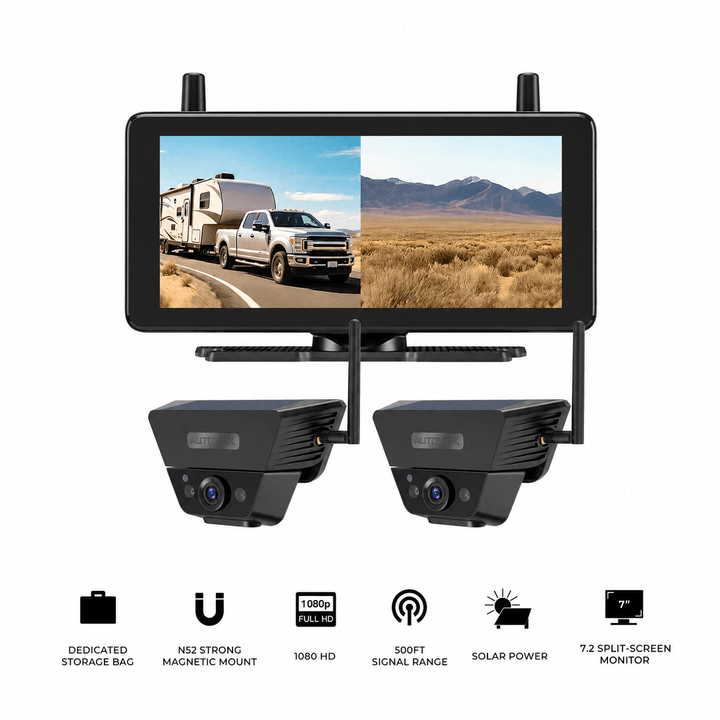
Prices and configurations may change. Confirm the current product page, vehicle compatibility, installation method, and power requirements before purchase.
Common Girls' RV Trip Planning Mistakes
Letting One Person Plan Everything
When one traveler manages the route, driving, campsite, food, and reservations, the trip becomes fragile when that person is tired or plans change.
Filling Every Hour
An overfilled schedule removes time for rest, fuel, parking, and unexpected experiences.
Choosing Stops Without Checking RV Access
A destination may have a parking lot without having a practical RV route or turnaround.
Saving the First Parking Practice for the Campground
Practise in an open area before the first crowded or dark arrival.
Letting Several People Direct the Driver
Choose one primary spotter. Others should use the shared stop signal only when necessary.
Continuing After Losing Sight of the Spotter
The vehicle should stop immediately until the spotter is visible again.
Assuming a Camera Shows the Complete Area
The screen may miss overhead, side, ground, or out-of-frame risks.
Treating Wireless as Power-Free
Wireless video still requires camera and monitor power.
Assuming Solar Means No Manual Charging
Solar charging is supplemental. Battery checks and manual charging remain necessary.
Turning a Missed Turn Into an Argument
Continue to a safe place, then recalculate the route. Avoid a sudden or unsuitable turn.
Arriving After Dark Without Saved Instructions
Save the entrance, gate code, site number, campground map, and backup option before service becomes unreliable.
Treating Women's Needs as an Afterthought
Restroom access, period care, medication, privacy, and personal-safety preferences belong in the main trip plan rather than a last-minute packing note.
Posting the Exact Campsite in Real Time
Public live-location posts can reveal where the group is staying. Share exact campsite content after leaving unless everyone has agreed otherwise.
Assuming Every Driver Fits the Same Setup
Each driver should reset the seat, mirrors, steering position, and display before moving the RV.
Using Gender Stereotypes to Explain Driving Stress
Driving pressure comes from vehicle size, experience, fatigue, traffic, and the maneuvering environment—not gender. Some women may have had fewer previous opportunities to practise with an RV, but confidence grows through preparation, correct vehicle adjustment, low-pressure practice, and supportive teamwork rather than stereotypes.
Frequently Asked Questions
How do you plan a girls' RV trip?
Choose shared experience themes, assign travel roles, set realistic driving days, confirm RV-friendly stops, practise parking, and prepare backup routes and overnight options.
How far should a group drive each day in an RV?
There is no universal distance. Consider road type, weather, driver experience, number of available drivers, planned stops, and the difficulty of the final arrival.
How should friends divide responsibilities?
Useful roles include driver, co-driver, campground lead, weather lead, food lead, vehicle-check lead, and photo lead. Roles can rotate during the trip.
What should the co-driver do?
The co-driver can manage navigation, provide turn instructions early, monitor signs, research fuel access, read campground directions, and reduce the driver's workload.
Should every person practise driving the RV?
Anyone expected to drive should practise in a safe, legal, open area before handling a busy fuel station, campground, or scenic stop.
How do you choose RV-friendly scenic stops?
Check parking length, entrance width, height restrictions, traffic flow, turnaround space, and whether a larger-vehicle parking area is available.
How should a group communicate while backing?
Use one primary spotter, simple pre-agreed signals, and a shared stop rule. The driver should stop whenever an instruction or view is unclear.
What should a spotter do?
The spotter should remain visible, stay outside the vehicle path, watch the agreed hazard, give short instructions, and signal stop before the clearance becomes uncertain.
What should the driver do if the spotter disappears?
Stop the RV immediately. Do not continue based on the previous instruction.
Is a backup camera useful for a group RV trip?
It can provide additional rear or side information and help the driver understand what the spotter is describing. It does not replace direct inspection or communication.
Can a backup camera eliminate RV blind spots?
No. Camera placement and field of view are limited, and overhead or out-of-frame hazards may remain invisible.
What is Smart Reversing Assist?
It can highlight people and vehicles detected within the parking guideline area. In single-screen mode, it provides visual boxes and audible alerts. In dual split-screen mode, it provides visual boxes without an audible alert.
Is Solar5B AI an autonomous parking system?
No. It does not steer, brake, or park the RV and does not identify every object or hazard.
What is the difference between Solar5C and WF4?
Solar5C is a dual-channel system with licence-plate and magnetic camera options. The multi-camera WF4 setup uses one rear and two side cameras and requires compatible installation and power connections.
Do wireless RV cameras still need power?
Yes. Wireless refers to video-signal transmission. The cameras and monitor still require the appropriate power source or battery.
Does solar charging remove the need for manual charging?
No. Solar charging is supplemental and varies with sunlight, weather, mounting angle, and usage.
Do DVR systems require an SD card?
Compatible local storage is required when DVR recording is used. An SD card is sold separately unless a product listing explicitly states otherwise.
What should the group do when arriving after dark?
Stop before the final space, confirm the location and host instructions, keep the group together, use exterior lighting, inspect the site when safe, and move to a backup stop when the situation feels unclear.
What women-specific items should be added to an RV checklist?
Consider menstrual products, sealed disposal bags, personal medication, hygiene supplies, a private changing plan, location-sharing rules, charged phones and flashlights, and a backup overnight stop.
How can an all-women group choose a more comfortable overnight stop?
Review current information, prefer a well-marked and well-lit location when practical, arrive before dark, share the plan with a trusted contact, and leave when the surroundings or interaction feels uncomfortable.
How should a shorter driver prepare to drive an RV?
Adjust the seat, mirrors, steering wheel, and approved vehicle controls until the pedals can be used comfortably and the road and mirrors are clearly visible. Practise before entering traffic and do not use an unapproved workaround that affects safe control.
How do you manage period care while boondocking?
Carry enough supplies, water, soap or hand sanitiser, opaque sealed disposal bags, and pain-relief or other personal items normally used by the traveler. Confirm local waste rules and pack out products where no suitable disposal is available.
Should the group share its campsite location on social media?
Consider delaying exact location posts until after departure, especially at remote or lightly occupied sites. Every traveler should agree before the group's live location or private images are shared publicly.
Can an RV backup camera improve personal security?
A camera may show selected areas around the vehicle during parking, but it is not a complete security or surveillance system. Use normal personal-safety planning and do not rely on the rear display to evaluate an entire campsite.
How can the trip stay flexible without becoming disorganised?
Reserve the important anchor stops, keep the days between them flexible, save backup overnight options, and decide who will update the route when plans change.
Final Thoughts: Make the RV Part of the Trip, Not the Stress
A memorable girls' RV trip is built around shared experiences, but it stays enjoyable because the group has also planned for fuel stops, weather, parking, fatigue, restroom access, privacy, personal safety, and campsite arrival.
Good preparation does not make the trip rigid. It gives the group enough structure to change plans without losing control of the practical details or asking someone to ignore a personal need to protect the schedule.
Choose the experiences everyone cares about. Give the driver and co-driver clear roles. Practise parking before the first campground. Use one spotter system and stop whenever the view or instruction becomes unclear.
Rear and side cameras may add useful context, but the group should continue to inspect the entire area and communicate calmly.
- Choose the shared experience priorities.
- Assign clear travel roles.
- Plan restroom, period-care, privacy, and personal-safety needs.
- Adjust the driving position for every driver.
- Set realistic driving days.
- Practise parking before departure.
- Agree on one spotter system.
- Test rear and side camera views.
- Save late-arrival instructions.
- Stop when the view or instruction becomes unclear.
- Leave room for the plan to change.
The RV should feel like part of the adventure, not a problem everyone has to solve at the end of every driving day.


