


“This plan covers thousands of RV components.”
That sounds reassuring when you are sitting at a dealership desk with a new RV purchase in front of you.
It also leaves out the questions that usually matter most when a repair actually happens.
Is your slide-out mechanism included? What if the failure started with a damaged seal? Does the plan pay the diagnostic charge? Can a mobile RV technician perform the repair? Does the provider need to approve the work before the shop begins? If the refrigerator fails three states away, can you use the service center that has an appointment tomorrow?
An RV extended warranty is easier to evaluate when you stop counting covered components and start reading the contract as a repair process.
In many cases, products marketed as an “RV extended warranty” are structured as extended service contracts or vehicle service contracts. The terminology, legal structure and consumer protections can vary by provider and jurisdiction, so the actual contract should guide the comparison.
The goal of this guide is simple: identify the systems you care about, understand the exclusions, calculate the real cost and know exactly what happens between the moment something breaks and the moment an approved repair gets paid.
There is also a second type of warranty RV owners encounter regularly: the manufacturer's warranty that comes with an accessory such as a backup camera.
Those two agreements serve different purposes. We will use AUTO-VOX's current product warranty and support process later in this guide as a practical example of how an accessory-brand warranty differs from an RV-wide extended service contract.
Quick Navigation
- Quick Buying Checklist
- 1. Inventory Existing Coverage
- 2. List the Systems You Care About
- 3. Understand the Contract Structure
- 4. Read the Exclusions
- 5. Calculate the Real Cost
- 6. Check the Repair Network
- 7. Understand Preauthorization
- 8. Ask How Repairs Are Paid
- 9. Keep Maintenance Records
- 10. Keep Doing Preventive Checks
- 11. Research the Provider
- RV Warranty vs. Accessory Warranty
- AUTO-VOX Warranty Example
- AUTO-VOX Support Resources
- Comparison Checklist
- Frequently Asked Questions
Contract reminder: Extended-warranty and service-contract terms vary by provider, state, RV type and purchase agreement. This article is a buying and contract-review framework rather than a coverage determination. Request the actual contract before purchase and rely on its definitions, covered components, exclusions, limits and claim procedures.
Quick Answer: What Should You Check Before Buying an RV Extended Warranty?
A useful comparison starts with the contract itself rather than the sales brochure.
| Question | Why It Matters |
|---|---|
| What protection do I already have? | Factory, component and dealer coverage may overlap with part of the new plan |
| Which RV systems worry me most? | A plan is more useful when it addresses the systems that matter on your specific rig |
| Is the contract stated-component or exclusionary? | The contract structure determines how you identify potentially covered items |
| What is excluded? | Wear, seals, water intrusion, maintenance and modifications can change how useful coverage is |
| What will I actually pay? | Contract price is only one part of the total cost |
| Where can the RV be repaired? | A traveling RV needs practical access to repair facilities away from home |
| Is preauthorization required? | Starting work too early may create a reimbursement problem under some contracts |
| How are approved repairs paid? | Direct payment and owner reimbursement create very different cash-flow needs |
| What records must I keep? | Maintenance documentation may be requested during a claim review |
| Can I cancel or transfer the plan? | These terms matter when selling the RV or changing plans |
If a salesperson cannot provide the contract before purchase, ask for it.
You need the language that will govern a future repair, not only a summary of benefits.
Step 1: Inventory the Coverage You Already Have
Before buying another contract, build a simple timeline of the protection that already follows the RV.
A new motorhome or trailer can have several warranties operating at the same time.
RV Manufacturer Warranty
The RV manufacturer may provide limited coverage for parts of the coach itself.
Check:
- start date
- end date
- mileage limit where applicable
- covered systems
- labor terms
- authorized repair requirements
Chassis or Powertrain Warranty
A motorhome chassis may carry separate manufacturer coverage for systems such as the engine, transmission or chassis components.
The expiration date may differ from the coach warranty.
Individual Component Warranties
Many systems installed in an RV come from separate manufacturers.
Examples can include:
- air conditioner
- refrigerator
- water heater
- generator
- leveling system
- slide-out components
- furnace
- electrical equipment
A component may still have its own warranty even after another part of the RV's original coverage has ended.

Dealer Plans
A dealer may offer a warranty, maintenance package, tire-and-wheel plan or service contract.
Write down exactly what each one is.
Similar names can describe very different products.
Insurance and Roadside Assistance
RV insurance handles a different set of risks, such as liability and applicable collision or comprehensive losses.
Roadside-assistance coverage may address towing or certain breakdown services.
A mechanical service contract has its own purpose.
Credit Card or Purchase Benefits
Some purchases may include additional benefits through a credit card, financing arrangement or retailer program.
Availability varies, so check the specific terms instead of assuming an extension exists.
What to remember: Put every existing warranty and service plan on one timeline. The gaps become much easier to see once the expiration dates are in one place.
Step 2: Make a List of the RV Systems You Actually Want Protected
The phrase “comprehensive RV coverage” is less useful than a list of the systems installed on your own rig.
A diesel motorhome with multiple slide-outs, automatic leveling and a generator creates a different repair profile from a smaller travel trailer with fewer powered systems.
Powertrain and Chassis Systems
For a motorhome, your list may include:
- engine
- transmission
- drive axle
- selected steering components
- selected braking components
- other covered chassis systems
Do not assume the phrase “powertrain coverage” includes every chassis component. Read the covered-component definition.
House Systems
Common priorities include:
- air conditioning
- furnace or heating system
- refrigerator
- water heater
- electrical system
- plumbing system
- control boards
- selected kitchen appliances
RV-Specific Mechanical Systems
These can become significant repair items:
- slide-outs
- leveling system
- generator
- powered entry steps
- selected awning components
Rank the Systems Instead of Treating Them Equally
Create three groups:
High concern: expensive systems you depend on regularly.
Medium concern: systems that matter but would not immediately stop the trip.
Lower concern: items you are comfortable repairing or paying for yourself.
Now compare each warranty proposal against that list.
A contract that includes hundreds of minor components can still be a weak fit if the systems at the top of your list have restrictive terms.
Step 3: Understand Whether the Contract Lists Coverage or Lists Exclusions
Two contracts can appear similar on a sales page while using very different structures.
Stated-Component or Named-Component Coverage
A stated-component contract identifies the systems or components that may qualify for coverage.
The practical reading rule is simple:
If an important component does not appear on the covered list, ask the provider how the contract treats it before assuming it is included.
Also check whether the contract covers:
- the complete assembly
- only named internal parts
- electronic controls
- sensors
- related seals or gaskets
- labor needed to access the component
Exclusionary Coverage
An exclusionary contract generally starts with broader mechanical-breakdown language and then identifies items, causes or situations that are excluded.
That can create broader potential coverage, but the exclusions, definitions and limitations still control the result.
Read these sections together:
- definitions
- coverage grant
- exclusions
- limitations
- maintenance requirements
- claim procedures
| Contract Style | Primary Reading Question |
|---|---|
| Stated / named component | Is the failed component specifically included in the covered list? |
| Exclusionary | Is the component generally within coverage, and does an exclusion remove the failure? |
The label alone does not tell you which contract is a better value for your RV.
Compare the actual language around the systems you ranked as most important.
Step 4: Read the Exclusions Before You Compare Prices
The exclusions section is one of the most useful parts of an extended-warranty contract.
It explains where the practical boundaries are.
Wear and Maintenance Items
Ask how the contract treats items such as:
- tires
- batteries
- belts
- hoses
- brake friction materials
- filters
- seals
- other normal-service parts
These items are often handled differently from a covered mechanical breakdown.

Seals, Water Intrusion, and Resulting Damage
This area deserves careful reading because several issues can overlap.
Suppose a slide mechanism is covered, but water enters around a neglected seal and eventually damages another component.
Ask the provider:
- Are slide seals covered?
- Is roof sealant maintenance excluded?
- How is water intrusion treated?
- How is resulting damage treated?
- What maintenance documentation is required for seals?
A covered slide motor does not automatically tell you how the contract treats a leak or seal-related failure.
Modifications and Aftermarket Equipment
RV owners customize their rigs frequently.
Ask how the contract treats:
- solar installations
- suspension changes
- aftermarket electronics
- towing upgrades
- owner-installed components
- non-factory appliances
The question is especially important when a modification could be connected to the cause of a later failure.
Maintenance-Related Failures
Review wording involving:
- lack of maintenance
- improper maintenance
- missed service intervals
- lack of lubrication
- improper winterization
- neglected seals
- overheating or contamination caused by poor maintenance
Pre-Existing Conditions
Ask the provider to define:
- pre-existing condition
- known condition
- prior failure
- inspection finding
- waiting period
If the RV already has an intermittent problem when the contract is purchased, understand how that condition will be handled.
Commercial, Rental, or Business Use
Coverage can depend on how the RV is used.
Ask about:
- commercial travel
- rental use
- delivery work
- business operation
- full-time residence
What to remember: Highlight the exclusions that could affect the expensive systems on your own RV. That exercise tells you more than the total number of components printed in a brochure.
Step 5: Calculate the Real Cost of the Warranty
The contract price is only the first number.
A more useful comparison looks like this:
Contract price + deductibles + uncovered diagnostic costs + possible mobile-service costs + owner-paid differences + cancellation costs where applicable.
Understand the Deductible Structure
Ask whether the deductible applies:
- per repair visit
- per repair order
- per covered component
- per failure
Those structures can produce very different costs when several problems are repaired at the same appointment.
Ask About Diagnosis
Useful questions include:
- Is diagnostic labor covered when the repair is approved?
- Is teardown covered?
- Who pays diagnosis if the failure is excluded?
- Does diagnosis require advance authorization?
Look for Coverage Limits
Check for:
- per-claim limits
- per-component limits
- aggregate contract limits
- limits tied to vehicle value
- special sublimits
Ask About Parts and Depreciation
The contract may describe:
- new parts
- remanufactured parts
- used parts
- depreciation
- betterment
- age-related reductions
Read that section before comparing a low premium with a higher-priced plan.
Step 6: Check Where You Can Actually Get the RV Repaired
Repair-network flexibility matters more in an RV than it does for many stationary products.
Your normal service center may be hundreds of miles away when the refrigerator, leveling system or slide-out stops working.
Ask What Type of Facility Is Allowed
Confirm whether the contract requires:
- a selling dealer
- a participating repair network
- a licensed RV repair facility
- an ASE-certified automotive facility for chassis work
- another qualified repair shop approved by the administrator
Ask About Mobile RV Technicians
Mobile service can be especially useful when the RV cannot easily move because of a slide, leveling or electrical problem.
Ask:
- Are mobile technicians allowed?
- Must the technician be approved first?
- Is the mobile service call covered?
- Are mileage or travel charges covered?
- Does the provider pay the technician directly?

Think About Where You Actually Travel
If you take long RV trips, ask about geographic restrictions.
Confirm how the contract handles travel in:
- other U.S. states
- Canada
- Mexico
- remote areas
Use the answer from the provider rather than assuming nationwide marketing language answers every travel scenario.
Step 7: Understand the Claim and Preauthorization Process Before Anything Breaks
A strong contract can still become frustrating if the owner does not understand the claim sequence.
Ask the provider to walk you through a normal repair from beginning to end.
A typical process may look something like this:
- A covered system develops a problem.
- The owner contacts the provider or approved repair facility.
- The repair facility diagnoses the issue.
- The diagnosis and estimate are submitted to the contract administrator.
- The administrator reviews the proposed repair.
- Authorization is issued for eligible work.
- The repair is completed.
- Payment follows the contract procedure.
Your contract may use a different sequence.
Ask About Preauthorization
Get clear answers to these questions:
- Can the shop begin diagnosis before calling the provider?
- Can the shop begin repair before authorization?
- Who contacts the administrator?
- What documentation must the shop provide?
- Does teardown need separate approval?
- What happens after business hours?
- What happens if diagnosis reveals an excluded cause?
A repair that seems urgent from the owner's perspective may still need authorization under the contract.
What to remember: Save the claim phone number and preauthorization instructions in your phone before the trip. A breakdown is a poor time to learn the process for the first time.
Step 8: Ask How Approved Repairs Are Paid
Two plans can approve the same repair and still create very different experiences at the service counter.
Direct Payment
Some administrators pay the approved amount directly to the repair facility.
The owner may then pay the deductible and any non-covered charges.
Owner Reimbursement
Other arrangements may require the owner to pay the shop and submit documentation for reimbursement.
If that is the process, ask about:
- required receipts
- proof of payment
- submission method
- reimbursement timeline
- payment method
Mixed Payment Arrangements
A contract may pay certain repair charges directly while leaving other costs to the owner.
Ask for examples involving:
- deductible
- diagnostic labor
- shop supplies
- freight
- mobile technician travel
- upgraded replacement parts
Step 9: Keep a Maintenance File for the RV
Maintenance records serve two useful purposes.
They help you manage the RV, and they create a history of the work performed on it.
Save documentation for:
- engine and chassis service
- oil and fluid changes
- generator maintenance
- roof inspections
- seal inspections
- winterization and de-winterization
- appliance service
- slide-out maintenance
- leveling-system service
- manufacturer warranty repairs
- extended-warranty repairs

Keep Receipts and Technician Notes
A dated receipt is more useful than remembering that “the roof was checked sometime last spring.”
Save:
- invoice
- date
- mileage where relevant
- work performed
- parts used
- technician findings
- photos where useful
A Simple Digital Folder Works
You do not need a complicated system.
For example:
RV → Maintenance → 2026 → Roof / Chassis / Generator / Appliances / Slides
Photograph paper receipts before they fade and keep a backup somewhere outside the RV.
Step 10: An Extended Warranty Still Leaves Preventive RV Checks With You
Warranty coverage and maintenance solve different problems.
The contract may help with an eligible mechanical or electrical repair.
Your routine inspections help you notice loose hardware, worn seals, low tires, damaged exterior equipment and visibility issues before a travel day.
Before departure, continue checking items such as:
- tires and pressure
- visible fluid leaks
- roof and exterior seals
- hitch and towing equipment
- storage doors
- lights
- bike racks and cargo
- camera mounts and camera views
Rear and Side Visibility Are Part of the Travel Routine
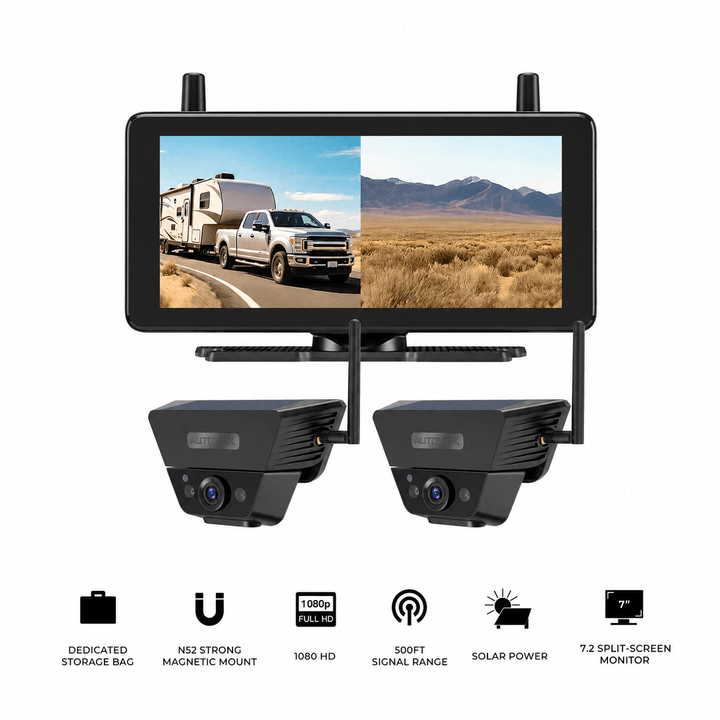
A portable system such as the Solar5B can provide a selected rear view during backing and campsite approaches.
The Solar5B Dual-Camera Kit adds a second movable camera angle for another selected perspective.
For larger RVs, the CampSync D1 uses three cameras and four lenses: one dual-lens rear camera plus two side cameras.
The WF4 multi-camera configuration uses one rear camera and two side cameras.
These systems can add selected visual context during driving and parking.
They do not diagnose mechanical failures, confirm that an RV is properly maintained or determine whether a warranty claim will be approved.
Step 11: Research the Company Behind the Contract
The brand name printed on a sales brochure may not be the only company involved in the contract.
Identify the parties named in the agreement.
Depending on the product, these may include:
- seller
- service-contract provider
- administrator
- obligor
- insurer or financial backing entity where applicable
Check the Service Process
Look at:
- claim phone number
- customer-service hours
- email support
- weekend availability
- repair-facility instructions
- complaint history
- consumer reviews about actual claims
Reviews should be read carefully. One customer's approved or denied repair does not tell you how your contract will respond, but repeated comments can reveal questions worth asking before purchase.
Check Transferability
If you may sell the RV before the contract ends, ask:
- Can the contract transfer to a new owner?
- Is there a transfer fee?
- How soon must the transfer be requested?
- What documents are required?
Check Cancellation Terms
Read:
- free-look or cancellation period
- prorated refund formula
- administrative fee
- mileage or usage adjustment
- claim-related deductions
- cancellation procedure
A long contract deserves an exit plan that is as clear as the purchase process.
RV Extended Warranty vs. an Accessory Manufacturer Warranty
RV owners often have both types of protection at the same time.
They are separate agreements.
| RV Extended Warranty / Service Contract | Accessory Manufacturer Warranty |
|---|---|
| May address multiple eligible RV systems | Applies to a specific manufacturer's product |
| Usually purchased separately | Usually accompanies the product purchase |
| Has its own contract administrator and claim process | Uses the accessory manufacturer's warranty process |
| May involve deductibles and repair-network rules | Uses the terms published for that accessory warranty |
| May address eligible RV mechanical or electrical breakdowns | Addresses eligible defects in the manufacturer's product |
| Exclusions depend on the service contract | Exclusions depend on the manufacturer's warranty policy |
If an aftermarket backup camera develops a problem, the RV extended warranty is not automatically the agreement you would use.
The camera manufacturer's warranty may be the relevant starting point.
This distinction is worth understanding for every accessory installed or carried on the RV.
Example: How the Current AUTO-VOX Product Warranty Works
AUTO-VOX's published warranty provides a useful example of an accessory-brand warranty with its own duration, eligibility rules and claim process.
Under the current official policy, AUTO-VOX products come with a 12-month warranty.
Registering an eligible AUTO-VOX product through the official website adds six additional months at no charge, bringing the published total warranty period to 18 months.
Warranty eligibility and after-sales handling should still be checked against the purchase region, retailer and current official policy at the time service is needed.
What the Published AUTO-VOX Warranty Focuses On
The current policy addresses eligible defects in original materials or workmanship during the warranty period.
When a covered defect is confirmed, the published policy describes replacement with the same or a comparable product at AUTO-VOX's option.
That is a different structure from an RV-wide extended service contract that may pay an approved repair facility for work on multiple systems.
The Warranty Also Has Exclusions
The current AUTO-VOX warranty policy lists conditions that can fall outside coverage, including situations involving:
- expired warranty period
- product misuse
- unauthorized reseller purchases
- product modifications
- insufficient proof of purchase
- lost or stolen products
- certain damage from acts of nature
- third-party repairs
- certain non-quality-related issues
The official terms should be reviewed directly because the exact wording controls the warranty.
This is a useful lesson for an RV extended warranty too: even a warranty covering one accessory has eligibility requirements and exclusions. A contract that potentially addresses an entire RV deserves careful review before purchase.
What to remember: Keep the RV service contract and each accessory manufacturer's warranty in the same maintenance folder, but treat them as separate agreements with separate claim procedures.
Where AUTO-VOX Owners Can Find Warranty and Technical Support
AUTO-VOX maintains an official Support Center for product and after-sales resources.
Current support resources include:
- FAQ
- warranty information
- extended-warranty resources
- warranty claim access
- manual downloads
- firmware updates
- video tutorials and product guidance
The current customer-service contact is service@auto-vox.com.
The official Warranty Policy also provides the current warranty terms and access to the warranty application process.
Third-Party Retailer Purchases
AUTO-VOX's current warranty page states that after-sales support policies for purchases made through third-party retailers may vary by retailer.
Keep the order confirmation and proof of purchase and check the applicable retailer process when needed.
This is another useful habit to carry over to RV ownership: always know which company is responsible for the agreement you are trying to use.
RV Extended Warranty Comparison Checklist
| Category | What to Verify |
|---|---|
| Existing protection | Factory, chassis, component, dealer and other active warranties |
| Contract type | Stated-component, exclusionary or another structure |
| Powertrain | Engine, transmission and applicable chassis components |
| House systems | Air conditioning, electrical, plumbing, refrigerator, water heater and other appliances |
| RV mechanical systems | Slide-outs, leveling, generator, powered steps and other important systems |
| Exclusions | Wear, seals, water intrusion, maintenance, modifications and other excluded causes |
| Pre-existing conditions | Definition, waiting periods and inspection rules |
| Contract cost | Total purchase price and financing impact where applicable |
| Deductible | Per visit, repair order, component or failure |
| Diagnosis | Who pays diagnostic and teardown charges |
| Limits | Per claim, per component and aggregate limits |
| Parts | New, remanufactured, used, depreciation or betterment terms |
| Repair facility | Network, dealer or qualified-shop requirements |
| Mobile repair | Whether mobile technicians and travel charges are allowed |
| Preauthorization | What must happen before diagnosis or repair begins |
| Payment | Direct payment, reimbursement or mixed process |
| Records | Maintenance and service documentation requirements |
| Transfer | Eligibility, deadline and transfer fee |
| Cancellation | Refund calculation, fees and procedure |
| Provider | Seller, administrator, obligor and other contract parties |
| Travel area | Geographic limits and cross-border rules |
AUTO-VOX Viewing Options for Routine RV Travel Checks
| Product | Viewing Need | Practical Role |
|---|---|---|
| CampSync D1 | Farther/closer rear + both sides | Multi-view option for larger RVs and longer rigs |
| WF4 | Rear + left/right views | Three-camera option for compatible larger RVs and trailers |
| Solar5B | Portable rear view | Straightforward rear perspective for parking and campsite approaches |
| Solar5B Dual-Camera Kit | Two selected camera angles | Main rear + movable second perspective |
Camera Options for Routine RV Travel and Parking


Prices, configurations and availability may change. Confirm the current product page, selected package, vehicle compatibility, mounting method and power requirements before purchase.
Common RV Extended Warranty Shopping Mistakes
Buying Before Checking Existing Warranty Dates
A new contract can overlap with factory, chassis or component coverage. Map the existing protection first.
Choosing a Plan by the Number of Covered Components
Read how the contract treats the systems you care about, including definitions, exclusions and limits.
Skipping the Exclusions Section
Wear, seals, water intrusion, maintenance and modifications can materially change how a contract responds.
Comparing Contract Price Alone
Deductibles, diagnosis, repair limits, mobile-service charges and owner-paid differences belong in the cost comparison too.
Assuming Any Shop Can Start Repair Work Immediately
Check repair-network and preauthorization rules before approving work.
Losing Maintenance Records
Keep service invoices, inspection records and receipts organized throughout the ownership period.
Reducing Maintenance Because the RV Has an Extended Warranty
Continue the manufacturer's preventive-maintenance schedule and normal inspections.
Confusing an RV Service Contract With an Accessory Warranty
The RV contract and the accessory manufacturer's warranty have separate terms, exclusions and support channels.
Frequently Asked Questions
What is an RV extended warranty?
An RV extended warranty is a common marketing term for protection that may help with eligible repairs after or alongside manufacturer coverage. Many products are structured as extended service contracts or vehicle service contracts. The legal form, covered systems and claim process depend on the provider and jurisdiction.
Does an RV extended warranty cover everything that breaks?
Coverage depends on the contract. A repair may need to involve an eligible component, an eligible cause of failure and compliance with the contract's maintenance and claim requirements. Exclusions and limits are therefore as important as the covered-component list.
Are RV slide-outs and appliances usually covered?
Many RV service plans offer coverage levels that include systems such as slide-outs, air conditioning, heating, electrical components, water heaters, refrigerators and leveling systems. Availability varies by plan, so confirm each specific system in the contract you are considering.
Does an extended warranty replace regular RV maintenance?
Regular maintenance remains part of RV ownership. Follow manufacturer service intervals, inspect seals and other wear areas, and keep maintenance records. Some contracts exclude failures associated with insufficient or improper maintenance.
What warranty does AUTO-VOX currently offer?
AUTO-VOX currently publishes a 12-month warranty for its products. Registering an eligible product on the official AUTO-VOX website adds six months at no charge, bringing the published warranty period to 18 months. Confirm eligibility, purchase region, retailer and the current official warranty terms when service is needed.
Where can AUTO-VOX users get technical or warranty support?
The official AUTO-VOX Support Center provides access to FAQs, warranty information, warranty claims, manuals, firmware updates and video resources. Current customer-service contact is service@auto-vox.com.
Final Thoughts: Read the Contract Before You Buy the Promise
An RV extended warranty can be easier to evaluate once you stop asking a broad question like “Is this a good plan?”
Replace it with smaller questions that can be answered directly from the contract.
- List every warranty and service plan you already have.
- Rank the RV systems you are most concerned about.
- Download the actual contract before purchase.
- Identify whether coverage is stated-component, exclusionary or another structure.
- Highlight the exclusions that affect your RV.
- Calculate the contract price, deductible and other possible owner costs.
- Confirm the repair-network and mobile-service rules.
- Understand the preauthorization process.
- Ask how an approved repair is paid.
- Check the coverage limits.
- Review transfer and cancellation terms.
- Save maintenance records throughout the contract period.
After purchase, keep the contract, maintenance documents and claim contact information somewhere you can reach while traveling.
Continue the same preventive inspections you would perform without an extended warranty. A service contract may help with an eligible repair; it does not remove the normal work of maintaining the RV.
Accessory warranties belong in the same records folder too.
For AUTO-VOX owners, the official Support Center is the place to check current warranty information, register eligible products, find manuals and firmware resources, contact customer service and start the applicable warranty process.
Before buying an RV extended warranty, download the contract, mark the exclusions and confirm the repair and authorization process in writing. For AUTO-VOX product support, use the official Support Center and current warranty policy so the information matches your product, retailer and purchase region.


